02-10-2025 | Coral North Reach Final Decision of Investment and Consolidated Mozambique as Energy Power

The President of the Republic, Daniel Francisco Chapo, presided this Thursday, 2 October 2025, in Maputo, the ceremony of the signing of the Final Investment Decision (FID) of the Northern Coral Project FLNG, one of the largest Liquefied Natural Gas (LNG) projects in development in the country, led by multinational ENI and its partners in Area 4.
22-09-2025 | 10th COORDINATING COUNCIL OF THE MIREME CLEARS WITH FOCUS IN REFORMS AND STRUCTURING PROJECTS
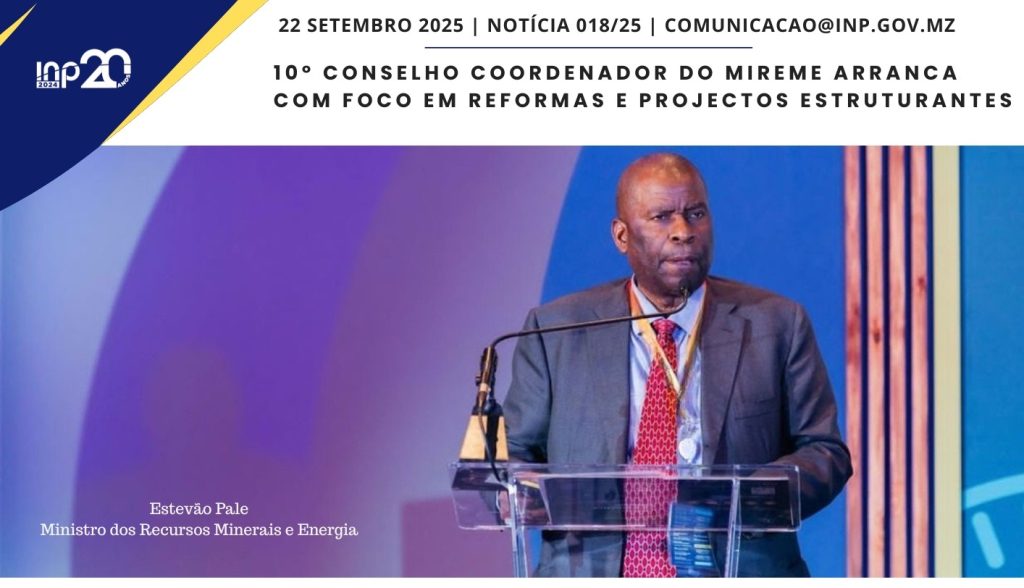
The Minister of Mineral Resources and Energy, Stephen Pale, opened this Monday the 10th Coordinator Council of the Ministry of Mineral Resources and Energy (MIREME), held under the motto "Promoting Access and Local Use of Mineral and Energy Resources, Towards Integrated Development of Mozambique." For two days, members of the government, technicians of the sector and [...]
PUBLIC AUDIT

THIRD CONCERNING THE ACQUISITION OF GEOPHYSICAL DATA IN THE SEDIMENTARY MOZAMBIQUE BASIS Following the need to extend the assessment of the oil potential of the national territory and coverage in geophysical data, the National Petroleum Institute (INP), announces the launch of the third tender for the acquisition of the above data on 17 September 2025, [...]
29-07-2025 | SADC-INP POINTS NATURAL GAS AS MOTOR OF ENERGY TRANSITION AND DEVELOPMENT IN THE REGION

The National Petroleum Institute (INP), representing the Ministry of Mineral Resources and Energy (MIREME), took part this Tuesday in the plenary session of the regional seminar "Parliamentary Leadership: Energy Transition and Economy of Oil and Gas in SADC", which takes place in Maputo, from today until 31 July. In the panel entitled "Experiences [...]
16-06-25 | INP POSISON MOZAMBIQUE AS A TECHNOLOGICAL PLATOFORM OF NATURAL GAS AT OSAKA EXPO 2025
Speaking to those present, the National Petroleum Institute (INP) today reaffirmed its ambition to become a reference in regulatory innovation and sustainable development of oil resources during its participation in the Osaka Expo 2025. By intervening in the celebrations of the National Day of Mozambique, in the panel subject to the theme "Emponsing Lives (Education, and Work using [...]
INP HIGHLIGHTS THE STRATEGIC ROMP IN THE DEVELOPMENT OF NATURAL GAS IN MOZAMBIQUE
The National Institute of Petroleum (INP) praised, this Wednesday, ( 04-06-2025) the decisive contribution of ROMPCO (Republic of Mozambique Pipeline Investments Company) for the growth of the natural gas sector in the country, during the gala dinner allusive to the celebration of the 25th anniversary of the company, an act preceded by the inauguration ceremony of its new office [...]
28-05-2025 | INP REAFFIRMS THE ROLE OF FUEL DIVERSIFICATION IN ENERGY TRANSITION
The National Petroleum Institute (INP) has been participating since 27 May at the II Energy Conference of the Community of Portuguese-speaking Countries (CPLP), which takes place at the Estoril Congress Centre in Portugal. The INP delegation is headed by Project and Development Manager José Branquinho. It should be noted that the INP is Vice [...]
THIRD LIMITED CONCERNING GEOPHYSICAL AND GEOLOGICAL DATA ACQUISITION – CONCERNING THE CONCERN
The National Petroleum Institute, communicates to service providers and the general public that the 3rd Limited Competition for the Acquisition of Systemic and Potential Data, launched on November 8, 2024, through its official website, was cancelled for reasons related to the need for review and improvement of the Terms [...]
20-05-25 | FACIM 2025 – INP STRENGTH PREPARATIVES UNDER MIREME COORDINATION

The Maputo International Fair (FACIM 2025) already handles various sensitivities in the energy and mining sector in the country and the National Petroleum Institute (INP) is at the forefront of the hydrocarbon sector preparations for the Jubilee edition of FACIM 2025, which marks the 60 years of the biggest [...]
05-05-25 | INP IS THE PAINELIST OF THE 11TH EDITION OF MMEC

The National Petroleum Institute is taking part this week as a prominent speaker in the 11th edition of the Conference and Exhibition of Mining and Energy in Mozambique (MMEC 2025), one of the most important regional forums dedicated to extractive sectors. Under the Ministry of Mineral Resources and Energy (MIREME), MMEC, gathers, in the capital of the country, decision-makers [...]

