Generic selectors
Exact matches only
Search in title
Search in content
Post Type Selectors

Projects

Existing projects

Project Participative Interest (%) Location Area Contract Type Year of Contract Scope Phase
PPA SPT 70 Mozambique Basin Pande/Temane Block Oil Production Agreement (APP) or PPA in English 2000 Hydrocarbon Research, Production, and Marketing In Production
IFC 5
HCM 25
PSA SPM 100 Mozambique Basin Pande/Temane Block Production Sharing Agreement (CPP) or PSA in English 2000 Hydrocarbon Research, Production, and Marketing Developing
FLNG Southern Coral MRV 70 Rovuma Basin Area 4 Research and Production Grant Agreement 2006 Hydrocarbon Research, Production, and Marketing In Production
ENH 10
Galp Energy Rovuma B.V. 10
KOGAS Mozambique Ltd. 10
Dolphin/Atum (Mozambique LNG) Total E&P Mozambique Area 1, Limited 26,5 Rovuma Basin Area 1 Research and Production Grant Agreement 2006 Hydrocarbon Research, Production, and Marketing In Force Major
ENH 15
Mitsui E&P Mozambique Area 1 20
NGOC Videsh Ltd 10
Beas Rovuma Energy Mozambique Ltd 10
BPRL Ventures Mozambique B.V. 10
PTT Mozambique Area 1 8.5
Rovuma LNG MRV 70 Rovuma Basin Area 4 Research and Production Grant Agreement 2006 Hydrocarbon Research, Production, and Marketing In Suspensive Condition
ENH 10
Galp Energy Rovuma B.V. 10
KOGAS Mozambique Ltd. 10
ROMPCO CMG 40 Inhambane and Maputo N/A Gasoduct Grant Agreement 2000 Hydrocarbon Research, Production, and Marketing Operation
Sasol 20
iGas 40
MGC GIGA 49,60 Inhambane and Maputo Area 4 Research and Production Grant Agreement 2006 Hydrocarbon Research, Production, and Marketing In Suspensive Condition
CDGM 25,20
ENH 25,20

Existing projects

Project Participative Interest (%) Location Area Contract Type Year of Contract Scope Phase
PPA SPT 70 Mozambique Basin Pande/Temane Block Oil Production Agreement (APP) or PPA in English 2000 Hydrocarbon Research, Production, and Marketing In Production
IFC 5
HCM 25
PSA SPM 100 Mozambique Basin Pande/Temane Block Production Sharing Agreement (CPP) or PSA in English 2000 Hydrocarbon Research, Production, and Marketing In Production
FLNG Southern Coral MRV 70 Rovuma Basin Area 4 Research and Production Grant Agreement 2006 Hydrocarbon Research, Production, and Marketing In Production
ENH 10
Galp Energy Rovuma B.V. 10
KOGAS Mozambique Ltd. 10
Dolphin/Atum (Mozambique LNG) Total E&P Mozambique Area 1, Limited 26,5 Rovuma Basin Area 1 Research and Production Grant Agreement 2006 Hydrocarbon Research, Production, and Marketing Developing
ENH 15
Mitsui E&P Mozambique Area 1 20
NGOC Videsh Ltd 10
Beas Rovuma Energy Mozambique Ltd 10
BPRL Ventures Mozambique B.V. 10
PTT Mozambique Area 1 8.5
Rovuma LNG MRV 70 Rovuma Basin Area 4 Research and Production Grant Agreement 2006 Hydrocarbon Research, Production, and Marketing Developing
ENH 10
Galp Energy Rovuma B.V. 10
KOGAS Mozambique Ltd. 10
ROMPCO CMG 40 Inhambane, Gaza and Maputo N/A Gasoduct Grant Agreement 2000 Hydrocarbon Transport Operation
Sasol 20
iGas 40
MGC GIGA 49,60 Maputo N/A Gas pipeline concession contract 2003 Hydrocarbon Transport Operation
CDGM 25,20
ENH 25,20

CAMPO in Production

O natural gas in the country, it is currently produced from three (3) fields, of which two (2) are located in the Mozambique Basin and one (1) in the Rovuma Basin. taking into account the existence of already approved development plans, it is expected that five more (5) fields will enter production.

Field Area Appeal Status Year of Discovery Start of Production Operator
Temane Pande/Temane Natural Gas production 1957 2004 SPT

CAMPO in Production

Natural gas in the country is currently produced from four (04) fields, of which three (03) are located in the Mozambique Basin (Temane, Pande and Inhassoro) and one (1) in the Rovuma Basin (Coral).

In view of the existence of already approved development plans, two more (02) fields are expected to enter production in the Rovuma Basin, namely Dolphin/Atum and Mamba.

Production in the Mozambique Basin began in 2004 through the Temane field and later the Pande Field. In 2022 began production in the Rovuma Basin, through the Coral Field. In 2025, it began production from Inhassoro field in the Mozambique Basin.
Field Basin Area Status Year of Discovery Start of Production Operator
Temane Mozambique Pande/Temane In production 1957 2004 SPT
2024 SPM
Pande Mozambique Pande/Temane In production 1961 2009 SPT
Pande 2025 SPM
Inhassoro Mozambique Pande/Temane In production 1965 2025 SPM
Coral Rovuma Area 4 In production 2010 2022 MRV

Production

Production of natural gas in Mozambique began in 2004 through the Temane field and later in 2009 reinforced with the start of production of the Pande field. In 2022, it started the production of natural gas through the Coral field, which is liquefied for sale in the international market

Production

Natural gas production in Mozambique began in 2004, through the Temane field and later in 2009, reinforced with the beginning of Pande field production. In 2022, it started the production of natural gas, through the Coral field, which is liquefied for sale in the international market.

PRODUCTION

Wells resulting from oil and gas operations in Mozambique

LNG Sold
0 Mton
LNG loadings
0
Natural Gas Sold
0 MGJ
Condensed Sold
0 M of bbl
LNG Sold
0 Mton
LNG loadings
0
Natural Gas Sold
0 MGJ
Condensed Sold
0 M of bbl

PPA

PPA

Natural gas

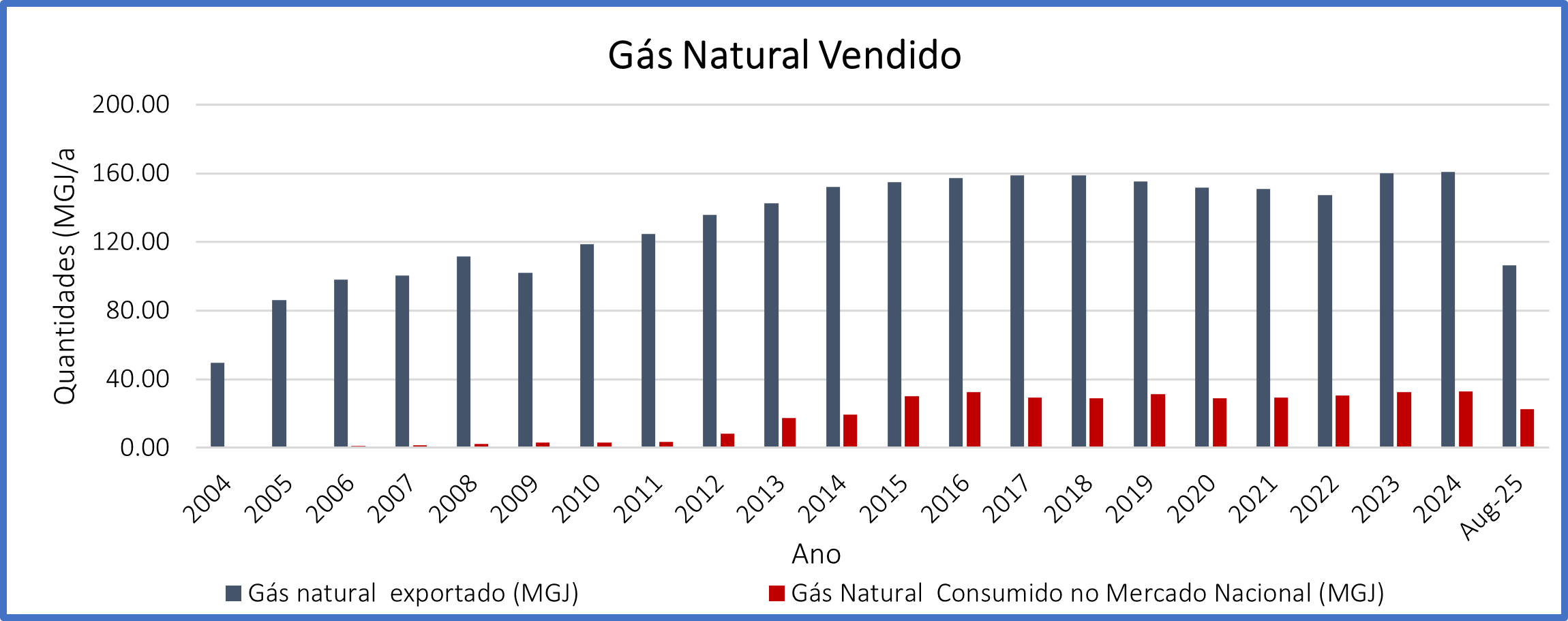
The cumulative gas produced (net production) from the start of production until July 2024 is 3.062.75 MGJ (Millions of Giga Joule), of which 2.707.74 MGJ was exported and 354.76 consumed on the national market (royalty in kind and commercial gas)

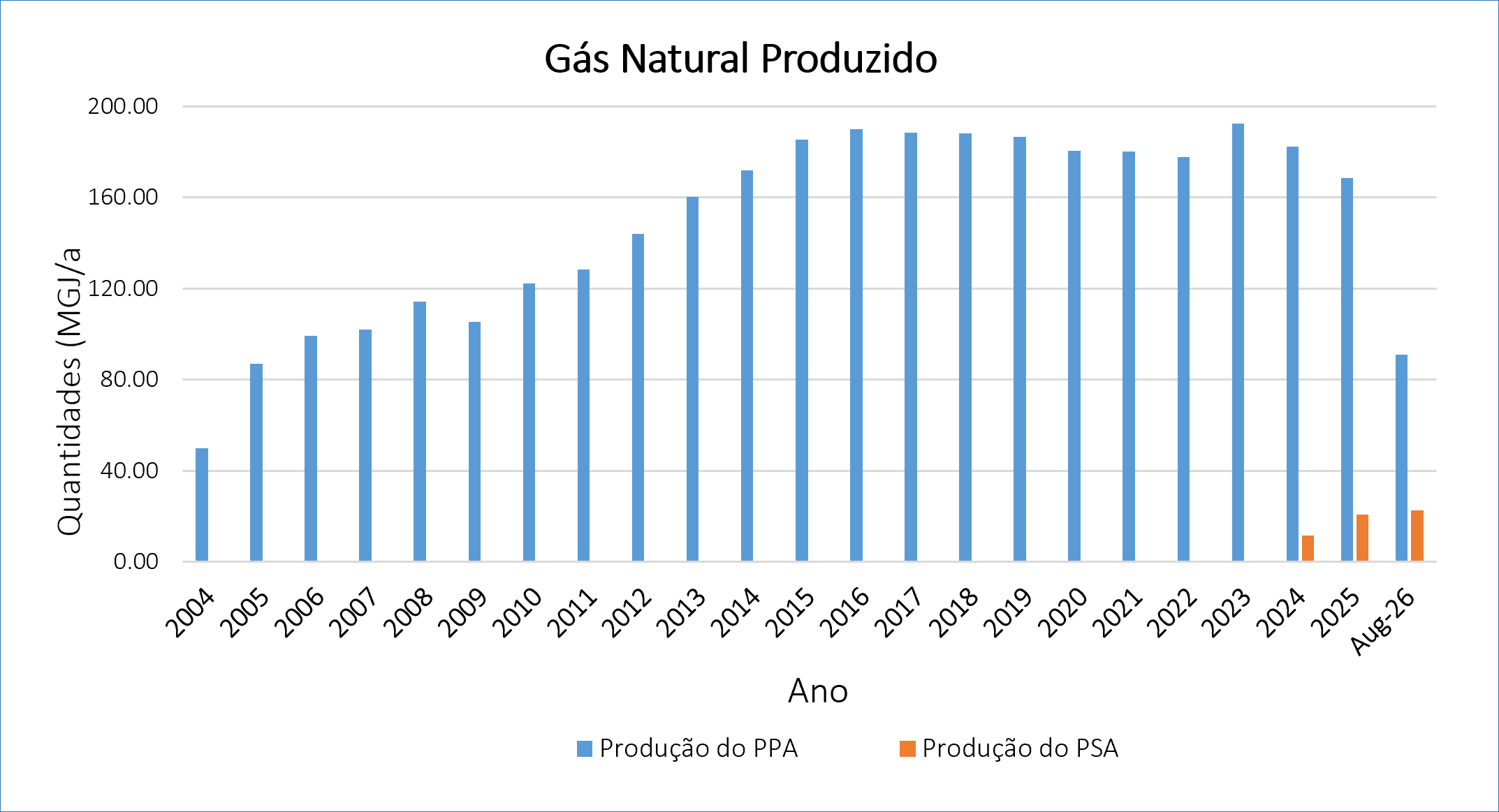
The graphs below illustrate the annual production profile of natural gas as well as the quantities exported and consumed on the national market.

Natural gas

Natural gas is produced from the fields of Pande, Temane and Inhassoro under the Oil Production Contract and Production Sharing Contract (PAP and PSA)

The cumulative gas produced (net production) from the beginning of production until October 2025 is 3.306.41 PJ (corresponding to about 79.481.009.615.615.38 m3), 3,278.66 PJ for PPA (corresponding to about 78.813.942.307.69 m3) and 27.75 PJ for PSA (corresponding to about 667.067.307.69 m3), as illustrated in the production profile chart below.

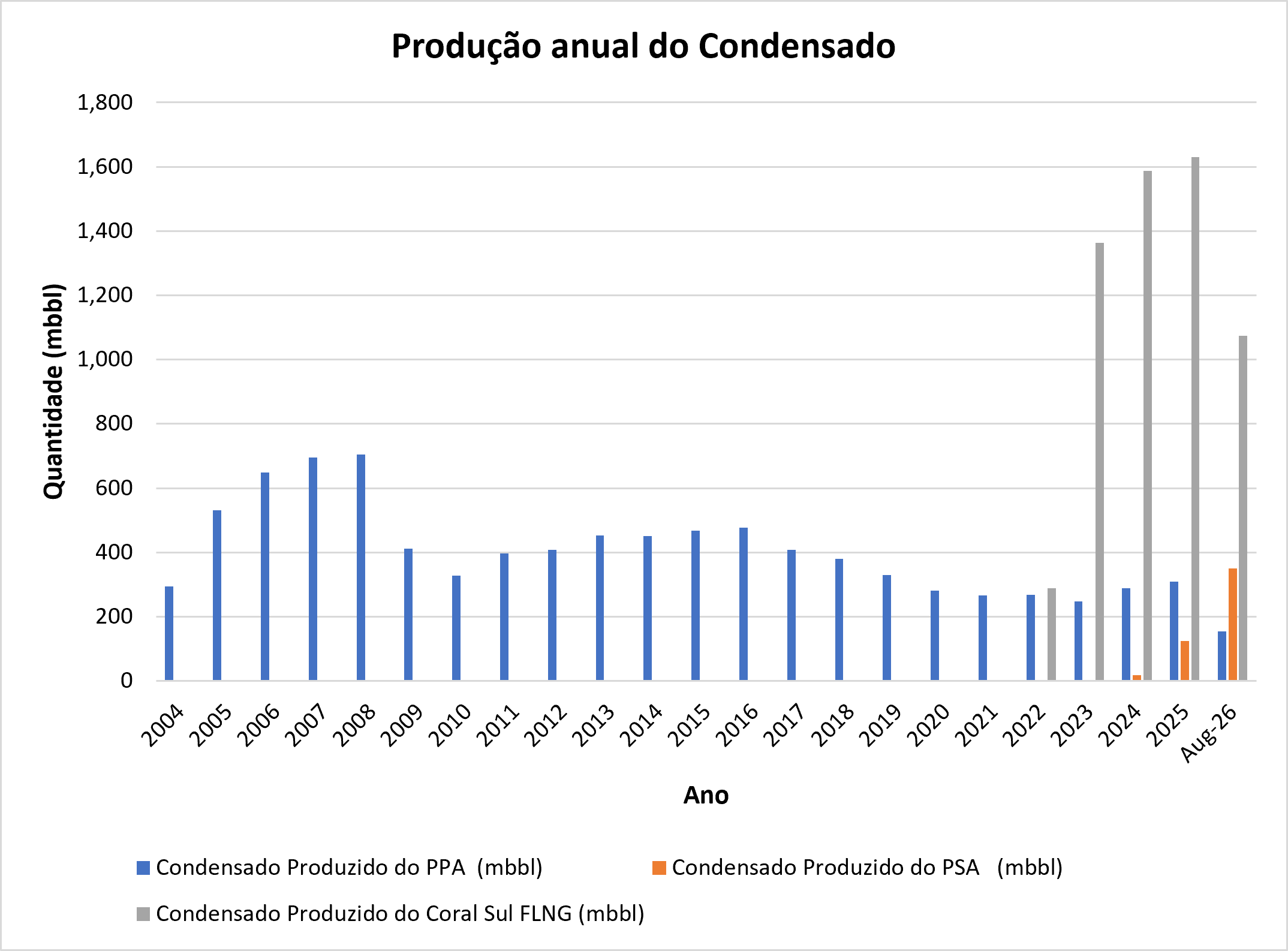
Condensed

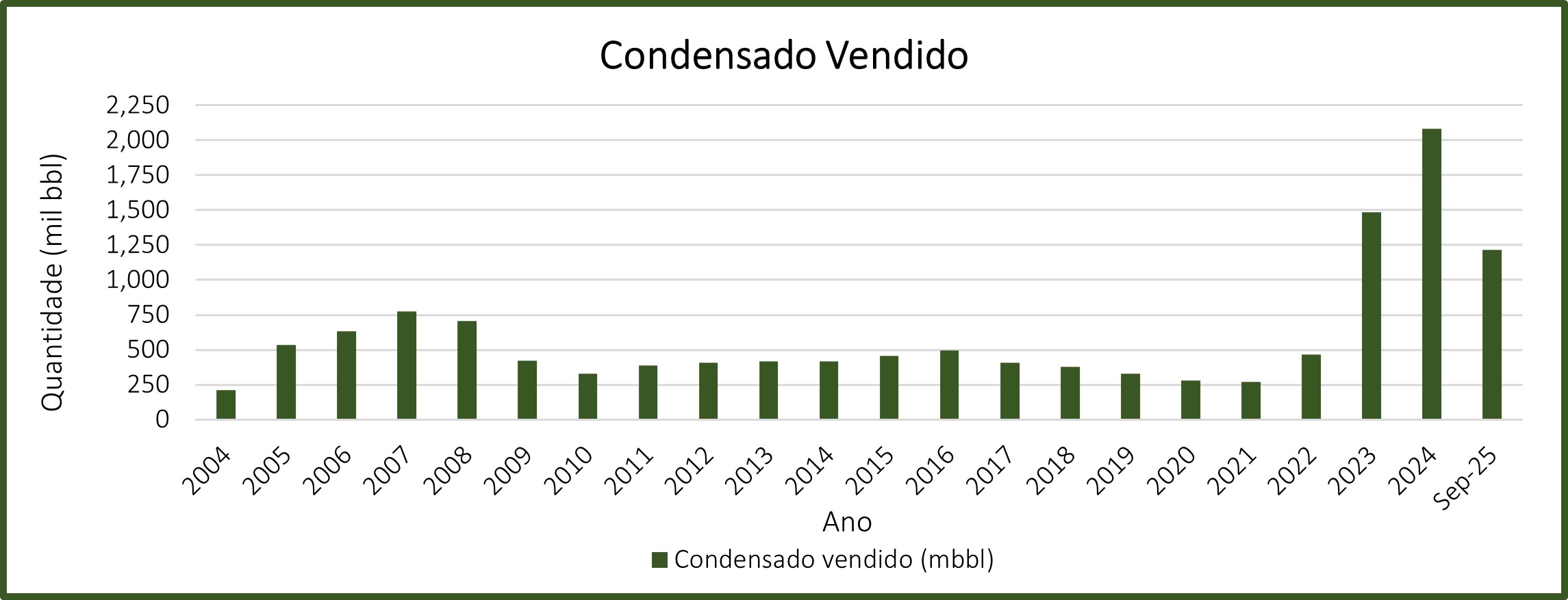
The condensate derived from gas production is stabilized at the Gas Processing Centre, stored and subsequently sold on the international market. From the beginning of production until July of the current year (2024) a total of 8,611,827.75 barrels were produced and a quantity of 8,530.463,25barris were sold.

Condensed

The condensate is obtained as a result of the production of natural gas under the different existing gas production contracts. Thus, until October 2025, a cumulative total of 13,859,239.13 bbl was produced, being 8,994,203.51 bbl produced from the PPA, 115,693.65 bbl from the PSA, and 4,749,341.97 bbl from the Southern Coral FLNG.

FLNG Southern Coral

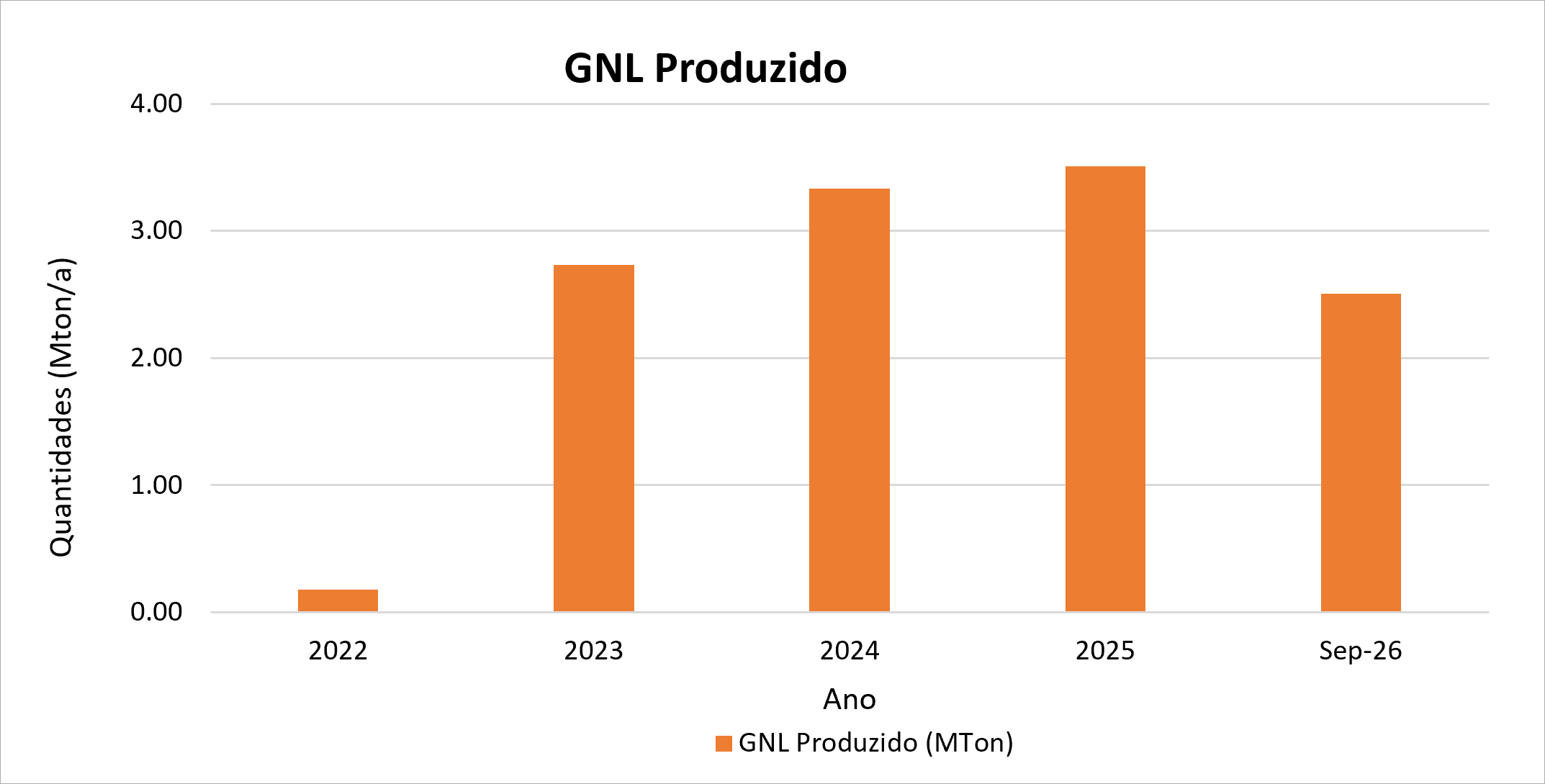
The South Coral FLNG project, from the beginning of production (October 2022) to July 2024, produced a cumulative of 4,677,786.96 tonnes of Liquefied Natural Gas (LNG) and exported a total of 4,660.188.99 tonnes of LNG, corresponding to 67 shipments.

FLNG Southern Coral

The South Coral FLNG project, from the beginning of production (October 2022) to July 2024, produced a cumulative of 4,677,786.96 tonnes of Liquefied Natural Gas (LNG) and exported a total of 4,660.188.99 tonnes of LNG, corresponding to 67 shipments.

For the condensate, from the beginning of production to July 2024, it produced a cumulative of 2,487,237.00 barrels of which 2,181,989,60 barrels were exported, corresponding to 10 shipments.

For the condensate, from the beginning of production to July 2024, it produced a cumulative of 2,487,237.00 barrels of which 2,181,989,60 barrels were exported, corresponding to 10 shipments.

Gas in the National Market

So far the gas used in the national market comes from the Pande and Temane fields and is used by more than 30 companies located in Vilanculos, Chokwe, Ressano Garcia, Machava, Matola industrial park, Beluluane, such as CTRG, Gigawatt, Mozal, Merec, Matola Industrial Company, Fasorel and Coca Cola SABCO (Moçambique). The other part was allocated to the National Hydrocarbon Company, E.P., for residential and commercial use in the districts of Vilanculos, Inhassoro, Govuro and Bazaruto archipelago in the province of Inhambane, as well as in Maputo and Marracuene, whose distribution began in 2014.

Liquefied natural gas (LNG)

Natural gas produced under the Area 4 Research and Production Grant Agreement (CCPP) under the Southern Coral Project FLNG is liquefied and stored for further loading (sale and export). From the beginning of production (October 2022) to December 2025 a cumulative of 9,493,377.7 tonnes of Liquefied Natural Gas (LNG Ton) was produced, corresponding to 21,646,728.0 m3 of LNG. A total of LNG corresponding to 21.550.584 m3 was exported from the quantity produced by 127 shipments.

Natural gas for the National Market

The Oil Operations Regulation provides that 25% of the oil and natural gas produced is made available for use on the domestic market. So far, the gas used in the national market comes from the Pande and Temane fields and is used by more than 30 companies located in Inhambane, Gaza and Maputo, such as CTRG, Gigawatt, Mozal, Merec, Industrial Company of Matola, Fasorel and Coca Cola SABCO (Mozambique) among others. As part of the availability of gas to the domestic market, it was also allocated to the National Hydrocarbon Company, E.P., natural gas for residential and commercial use in the districts of Vilanculos, Inhassoro, Govuro and Bazaruto archipelago in the province of Inhambane, as well as in Maputo and Marracuene, whose distribution began in 2014.

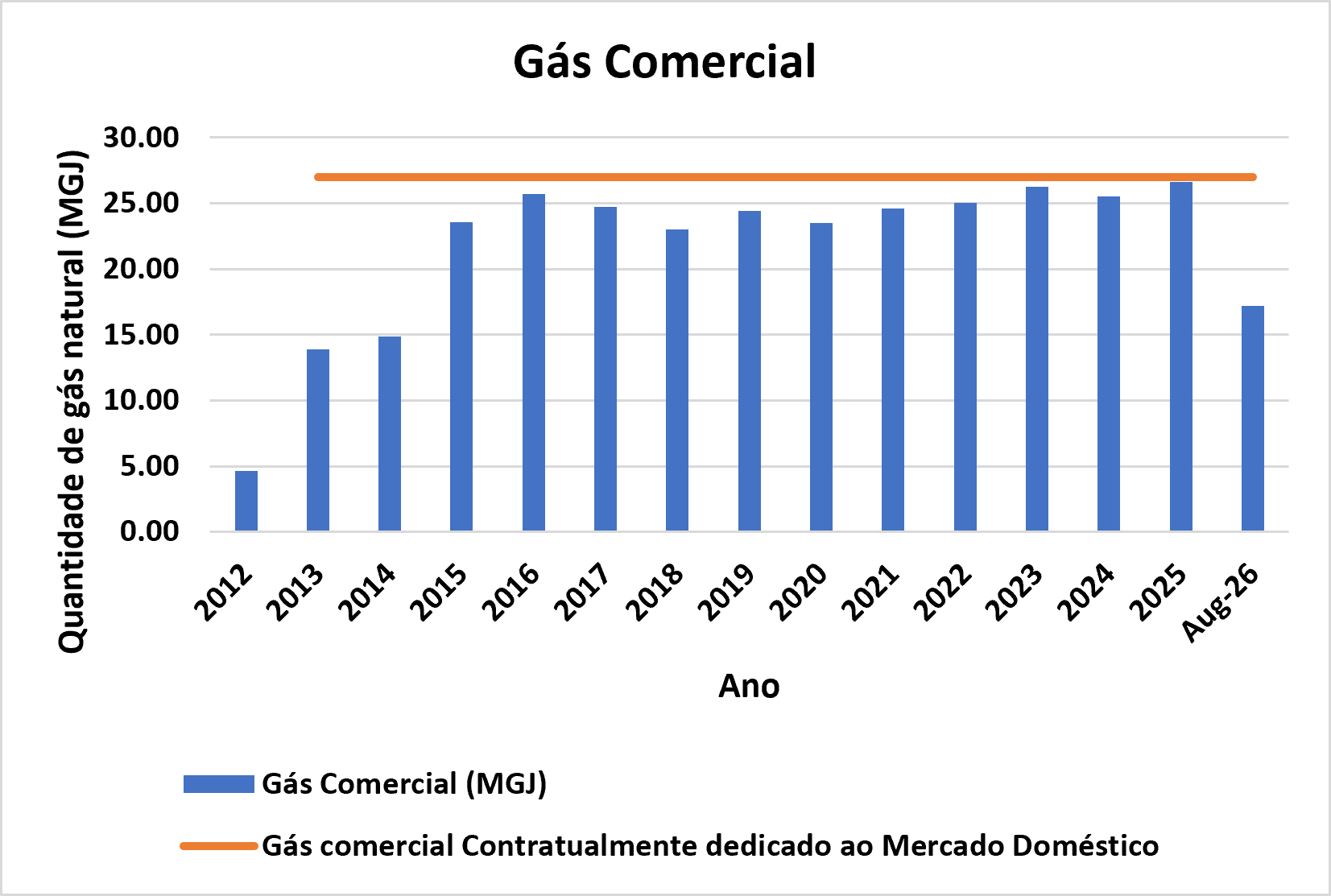
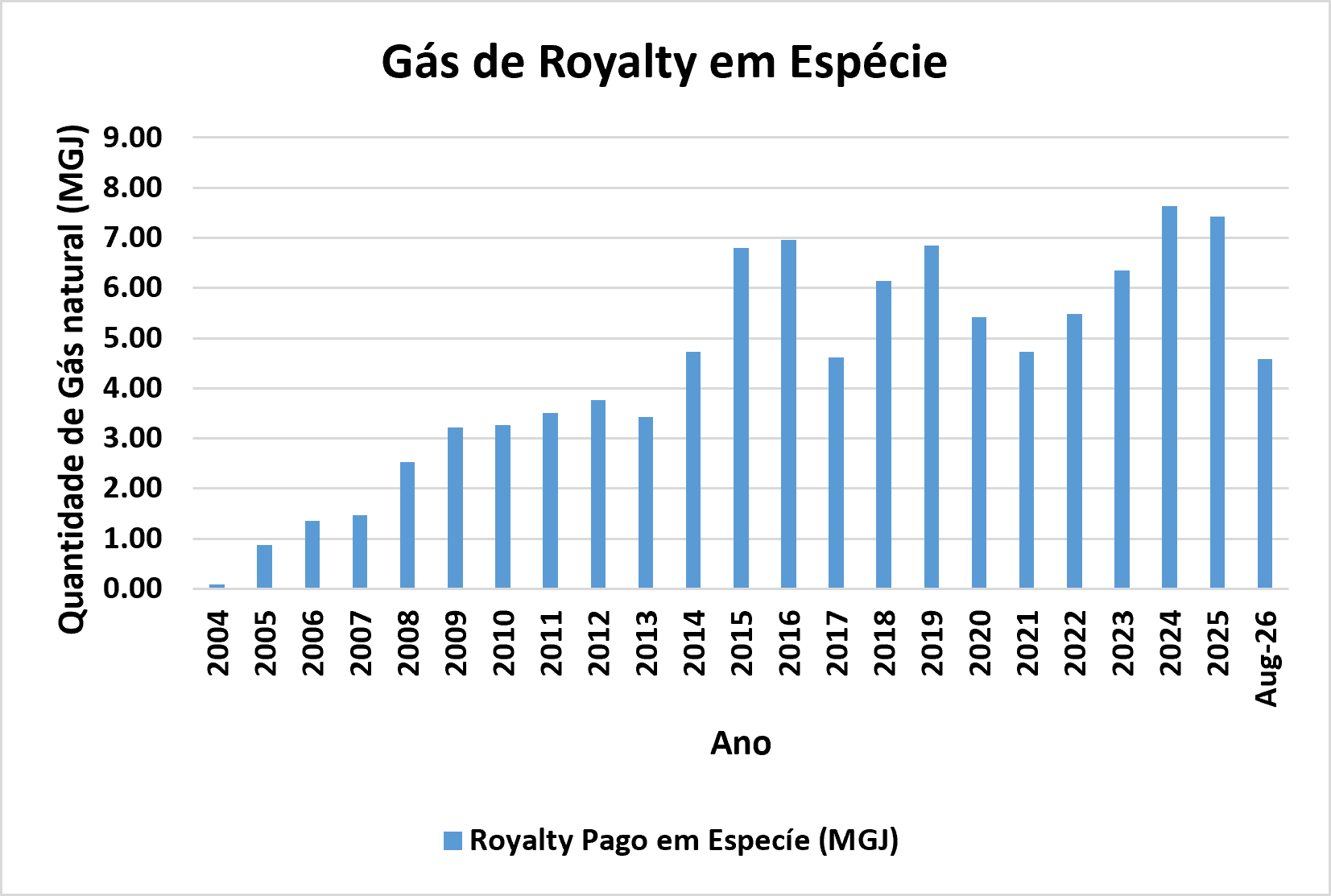
Natural gas currently in use on the domestic market is subdivided into two categories, namely royalty gas, which is the result of the Tax on Production and Commercial Gas.

Commercial Gas

Since the entry into force of the Purchase and Sale Agreement for the national market in 2013, around 234.8 MGJ (79.06%) of a total of 297 MGJ have been marketed.

Commercial Gas

Since the entry into force of the Sales Contracts for the national market in 2013 (GSA3) that advocate the sale of gas to CTRG, MGC Gigawatt, ENH Kogas and ENH were marketed by October 2025 around 297,36MGJ 80.89% of the total foreseen (351 MGJ).

Royalty Gas

From the beginning of production until 2023 the total gas of the Oil Production Tax (IPP) was 143.95 MGJ of which were paid in kind 81.59 MGJ. And in cash 62.35 MGJ. That is, the country over this period used about 56.68% of Royalty gas.

Royalty Gas

From the beginning of production until October 2025, a total of 159.15MGJ of which 48MGJ were paid in kind and 63.27MGJ in cash were delivered as Oil Production Tax.

With the approval of liquefied natural gas production projects in the Rovuma basin, it is expected that they will be made available for use in different projects on the domestic market just over 900 million cubic feet of gas per day (MMscf/d).

Description of PROJECTS

Description of PROJECTS

The Oil Production Contract (CPP), concerning the unified blocks of the Pande and Temane fields (on land), was concluded on 26 October 2000 between the Government of Mozambique, the National Hydrocarbon Company, E.P., Sasol Petroleum Temane Lda. and the Mozambican Hydrocarbon Company, SARL. to produce and market natural and condensed gas in markets in Mozambique and South Africa.

The gas produced from these fields is processed at the Natural Gas Processing Center (CPF) in Temane and transported by a pipeline (Mozambique to Seconda Pipeline-MSP) of about 867 km of extension, for supply in the national and South African market.

Natural gas production began in 2004, with a contract capacity of 120 Million Giga Joules/year (MGJ/a) through the First Gas Sale Contract (GSA1), and which suffered successive expansions until reaching the current contract capacity of 197 MGJ/a, accommodating the contractual obligations of the first, second and third gas sales contract (GSA1, GSA2 and GSA 3) including the IPP;

The IPP due to the Government under the APP corresponds to 5% of gas produced and sold and may be delivered in kind or in monetary value.

The APP in addition to the supply of gas to the South African market through GSA 1 & 2, also includes the provision of 27 MGJ/a to the national market through GSA3. This combined amount of IPP in kind (about 9 MGJ/a) is used on the national market for electricity generation, vehicle supply, homes and fuel in different industries, as described in the section on natural gas for the domestic market (2.3.6).

The Production Sharing Agreement (PSA) was concluded in October 2000 between the Government, ENH and Sasol Petroleum Mozambique Lda (SPM), with the objective of researching, evaluating, developing and producing non-associated natural gas and light oil from areas adjacent to the APP area.

Under contract, the Field Development Plan was approved in 2015 and in 2020 the respective amendment aimed at producing natural gas and light oil from the deposits of Inhassoro, Temane and Pande, to enable the construction of an Integrated Processing Infrastructure (IPF) with the following specifications :.

  • Production of 30 000 GPL TPA dedicated to the national market;
  • Production of 4 000 bbl/d of stabilized light oil for export;
  • Production of 30 PJ Natural Gas for electricity generation through Temane Thermal Power Plant (CTT) with capacity of 450 MW and
  • Export of surplus natural gas.

The infrastructure was commissioned and opened on 3 December, and production is expected to start in December 2025.

On 26 October 2000 the terms and conditions of the Mozambique-Sacunda Gas pipeline Agreement (Mozambique – Second Pipeline_MSP) were concluded between the Government (represented by the Ministry of Mining and Energy Resources), Sasol Limited (Sasol) and Mozambique Pipeline Investments Company Limited (ROMPCO), with the aim of transporting natural gas from Pande and Temane fields to supply the national and South African market.

Under this contract and in accordance with the approved Gasoduct Development Plan, ROMPCO was granted the right to build and operate the 26-inch diameter pipeline, 867 km long and capable of transporting 122 MGJ/a.

With the increase in gas demand, the gas pipeline capacity was increased to 212 MGJ/a by installing a compressor on the South African side and two pipelines parallel to the main pipeline (Looplines) on the Mozambican side, as illustrated in the figure below.
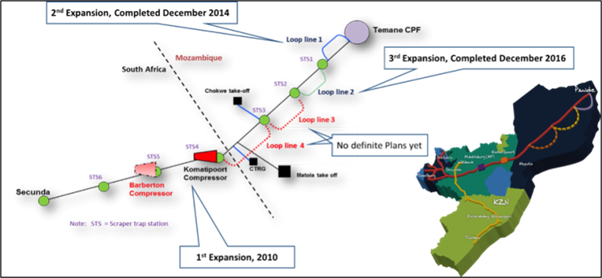
Figure: MSP pipeline

The pipeline in question has 05 take points on the Mozambican side, which can be used as connecting points for the supply of natural gas in the southern region of the country.

Under the Gasoduct Grant Agreement signed in January 2003 between the Matola Gas Company (MGC), Gigajoule Africa Ltd, (GIGA) and the Government of the Republic of Mozambique, MGC has been granted the right to build and operate an 8-inch transmission pipeline and 70 km long, to transport natural gas from the Pande and Temane fields of the MSP pipeline take point in Ressano Garcia to Matola and to provide the various industries, services and housing in Maputo province.

Operated by MGC, the pipeline provides natural gas to the distribution network of Maputo and Marracuene and supplies gas to more than 30 companies including Maputo thermal power station.

Research and Production Grant Agreement (CCPP), for Area 4, in the Rovuma Basin was concluded between the Government and Eni East Africa, S.p.A. (EEA) and National Hydrocarbon Company, E.P (ENH), holding 90% and 10% respectively. Currently, the shareholder structure of Area 4 includes the Mozambique Rovuma Venture (MRV) SpA that is a Joint Venture co-ownership of Eni, ExxonMobil and CNODC, with 70% of participatory interest, National Hydrocarbon Company E.P. (ENH), with 10% of participatory interest, Galp Energy Rovuma B.V.. with 10% of participatory interest and KOGAS Mozambique Ltd..with 10% of participatory interest.

Area 4, located approximately 250 km northeast of the city of Pemba (Provincia de Cabo Delgado), 50 Km from the coast, measured from the western border of the concession, at depths of water ranging from 1,800 to 2,600 meters. The Area is about 70 km wide and 200 km long. To the west, a straight line border divides Area 4 of Area 1.

In order to maximize the production of the Coral Eocene 441 warehouse, the MRV, Area Operator 4 submitted the proposal of the Development Plan (PdD) of the Northern Coral Project FLNG consisting of the construction of a floating natural gas processing and liquefaction infrastructure (FLNG) for the production of 3.55 MTPA of liquefied natural gas, installation of wells and underwater production systems, storage and loading of LNG and condemned, which was approved by the Council of Ministers by Decree No 9/2025 of 11 April.

With the approval of this PD it is expected that they will be available for use in the domestic market up to 25% of the total oil and gas to be produced, and 10% will be available at the beginning of production, i.e. in the second half of 2028.

Following the approval of the PD of the Northern Coral Project FLNG, the Concessionary took on October 2, 2025, in Maputo, the Final Investment Decision that consolidated Mozambique as an Energy Power, positioning the country as the 14th largest exporter of LNG and the 4th in Africa. The project envisages an investment of around 7.2 billion dollars and start of production for 2028.

Under the CCPP, the Government approved the Southern Coral Project Development Plan FLNG, for the development of Coral Eocene 441, with the aim of producing and marketing natural gas through a natural gas Liquefaction Floating Unit, with the capacity to produce 3.37 MTPA (Million tonnes per year) of Liquefied Natural Gas (LNG) subsequently expanded to 3.55 MTPA. In addition to the LNG the condensate is produced and exported from this project.

The final Investment Decision for the implementation of the project was reached in 2017 and started the construction of the Southern Coral FLNG oil infrastructure in 2018,

In 2022, the Oil Infrastructure docked in Mozambican territorial waters and the anchoring process, inspections, inspections and certifications began in accordance with the applicable legislation that culminated in the issue of the operating licence in August 2022.

The production of LNG through the project began in October 2022 and in November of the same year the first shipment of LNG and Condensed dedicated to export was carried out.

On 26 December 2006 the terms of the Oil Research and Production Agreement were approved, "CCPP", to Area 1, Offshore of the Rovuma Basin, concluded between the Government, Anadarko Mozambique Area 1 Lda., as Dealer and Operator, (AMA 1 or Operator) and National Hydrocarbon Company, E.P. (ENH), with a participation of 85 and 15%, respectively. Currently, the participating interests in this Area 1 include TotalEnergies E&P Mozambique rea1, Lda. (TEPMA1) with 26.5%, Mitsui E&P Mozambique Area1 Limited (MEPMOZ) with 20%, the National Hydrocarbon Company, E.P. (ENH) with 15%, BPRL Ventures Mozambique B.V (BPRL) with 10%, Beas Rovuma Energy Mozambique Limited (BREML) with 10%, NGOC Videsh Rovuma Limited (ONGC Videsh) with 10% and PTTEP Mozambique Area1 Limited (PTTEP MZA1) with 8.5%.

Under the CCPP, the Government approved the Development Plan of the Golf Course/Atum, for the development of the Golf/Atum Project (Mozambique LNG) consisting of the production of Liquefied Natural Gas (LNG) through two Natural Gas Liquefaction Modules, with a capacity of 6.56 MTPA each, totaling 13.12 MTPA (Million Tons per Year). In addition to LNG production, the project provides for the provision of a total of 400 MMscfd for the domestic market, with 100 MMscfd being first provided.

In June 2019, the Operator announced the final investment decision (FID) for the implementation of the project.

In May 2021, Area 1 Operator declared the Force Major and consequent interruption of activities in Palma and Afungi. The force major was lifted to continue the project.

In addition to the deposit Coral Eocene 441, the Dealers of Area 4 intend to develop Campo Mamba, through the Rovuma LNG Project Development Plan, to be implemented on land. The same was approved by the Council of Ministers by Resolution No 29/2019 of 05 June. .

The Rovuma LNG Project consists of two Natural Gas Liquefaction Modules, with a capacity of 7,6 MTPA each, totaling 15,2 MTPA (Million tons per year), through the resources from the Mamba field located in Area 4 offshore From the Rovuma Basin.

The development of the activities related to this project has suffered a setback due to the instability and security situation in the north of Cabo Delgado Province, which led to the Area Operator 1 Offshore of the Rovuma Basin to activate the Force Major clause and consequent interruption of activities in Palma and Afungi, facilities shared by Area 1 and Area 4, forcing concessionaires to maintain the project in suspensive conditions.

EnglishenEnglishEnglish

AREA 1

Following the 2nd open competition for the granting of areas for the research and production of hydrocarbons, the companies Anadarko Mozambique Area 1 and the National Hydrocarbon Company were awarded Area 1 in offshore environment of the Rovuma Basin. The area is located in the northern part of Cabo Delgado Province, in shallow to very deep waters. The Hydrocarbon Research and Production Areas Grant Agreement (CCPP) was signed on 20 December 2006 and is effective as of 1 February 2007.

PROSPERITY DISCOVERING AREA

Median estimate of 43 tcf (cubic foot trillions) of gas.

4 Transzonal Reservoirs:

  • Upper North Oligocene;
  • Upper South Oligocene;
  • Oligocene Lower;
  • Upper Eocene;

TUBARAN DISCOVER AREA

Median estimate of 3.4 (cubic foot trillions) Tcf of natural gas.

THE AREA OF DISCOVERMENT

Median estimate of 8.4 Tcf (cubulated foot trillions) of natural gas

The Paleocene Reservoirs.

THE AREA OF DISCOVERMENT

Tigris Shark Discovery Area (1254 km2), has 3 reservoirs of the Cretaceous (K1,K2 and K3), the K2 being the best in Orca and Shark-Tigre and has a median estimate of 0.323 Tcf (cubic foot trillions) of natural gas.

UNKNOWN TUGRE AND ORCA (CRETACICO LEQUE 1, 2 E 3), ROVUMA OFFSHORE AREA 1

The complete technical evaluation of the potential of the Cretaceous in Area 1, between the Areas of Discovery Tubarão Tigre and Orca, determined that it contains small, discontinuous and low quality reservoirs, and this would probably present significant challenges in the supply of trade amounts of gas. Of the three reservoirs of Cretaceous (K1,K2 and K3) evaluated, the best is K2 in Orca and Shark-Tiger that has an average resource of 0.323 Tcf (cubic foot trillions) of natural gas.

FOUND OUT ORCA (LECK OF MEDIO PALEOCEN), ROVUMA OFFSHORE AREA 1

This discovery was made in Area 1 by Anadarko in 2013 through borehole Orca-1, whose reservoir is the age of the Middle Paleocene, was subsequently evaluated by the holes Manta-1, Orca-2, Orca-3 and Orca-4.

The discovery is located about 10 km from the coast line, 250 km from the city of Pemba. This reservoir is of Middle Paleocene age and is not shared. The average estimate of resources is about 8.4 Tcf (cubulated foot trillions) of natural gas in situ, according to estimates submitted by Total.

The reservoir in the Orca discovery lies at depths ranging from 4000 to 5000m below the mid sea level, and the water column from about 600m to 1200m. The extension is about 30 km.

UNCOVERED TUBARON (EOCENO), ROVUMA OFFSHORE AREA 1

This discovery was made by Anadarko in January 2011 through the Jaw-1 hole and evaluated by the Shark-2 hole (negative) in 2013. The discovery is located about 25 km from the coast line, 50 Km of the Northeast of the district of Mocímboa da Praia and 200 Km of the Northeast of Pemba City.

The reservoir is completely in Area 1. The average estimate of resources is about 3.4 tcf (cubic foot trillions) of gas in situ.

The reservoir is at a depth of 3500 to 4000 metres below the average sea level. The water column ranges from 800 to 1200 meters. The extent of the Shark discovery is about 20 km east-oriented.