Mozambique is witnessing a crucial breakthrough in the preparation of its human capital for the Liquefied Natural Gas industry (LNG), with the return to the country on Saturday (12) of the delegation composed of 14 technicians from various public institutions, after the completion of a specialized training in Liquefied Natural Gas (LNG) in Tokyo, Japan.
The delegation included executives from the Administrative Court, the Ministries of Economics and Finance, the Tax Authority, the National Hydrocarbon Company, E.P. (ENH) and the National Petroleum Institute (INP).
The initiative is part of the bilateral cooperation programme, resulting from a Memorandum of Understanding between Japan Organization for Metals and Energy Security (JOGMEC), INP and ENH. The focus is training to manage the country's vast resources efficiently and sustainably.
One of the highlights of the training was the interaction with large operators in the Japanese industry, as highlighted by Neltone Foquiço, a technician at the National Petroleum Institute (INP), in the closing speech. According to the representative of the delegation, sharing experience and know-how Mitsui Corporation, JGC and Tokyo Gas contributed decisively to the strengthening of the technical capacities of the participants.
The mutual interest of Mozambique and Japan in deepening bilateral cooperation in the oil and gas sector was also highlighted by Neltone Fochiço, who underlined high-level institutional support. "The presence of Mozambique's Ambassador in Japan, Alberto Paulo, reaffirms the Government's commitment to support this cooperation and to promote a shared vision of energy progress," he said.
PCA of the INP Praises Results and Practical Application
The relevance of training for the future of the sector has been strengthened by the leadership of the INP. "It is gratifying to realize that the members of this edition of the JOGMEC training took full advantage of this opportunity "the PCA of the INP said. Mr Bangalane said that it is important for all beneficiaries to value knowledge by making effective and systemic application of techniques in the different sectors of activity.
Trainees return to the country with a global and innovative view of industry. For Luísa Nhanisse, the experience was transformative, stressing that it is one of the most relevant opportunities for training, with direct impact on the improvement of working methodologies and the adoption of international standards of excellence.
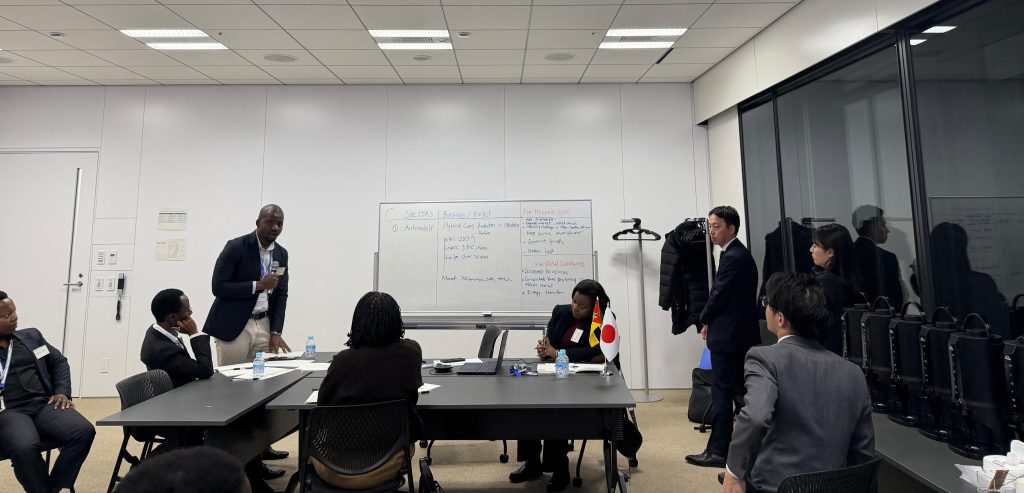
Similarly, Adérito Matevele, from the National Hydrocarbon Company (ENH), and Miguel Chamba, from the Administrative Court, highlighted the value of the technical immersion provided by the training. According to Matevele, the programme has made it possible to deepen the technical and contractual aspects of the oil and gas sector at international level, an essential element in enhancing transparency and maximising the return of national resources. Miguel Chamba, in turn, stressed the importance of the knowledge acquired on the architecture of large LNG contracts, which is crucial for the effective exercise of the functions of supervision and control of tax and tax legality.
This training represents a significant contribution to institutional strengthening by providing the entities involved with up-to-date and strategic skills, which are fundamental to the sustainable development of Liquefied Natural Gas (LNG) projects in Mozambique.
It is recalled that training is part of the bilateral cooperation programme for the training of Mozambican executives in the oil and gas sector, aiming at the efficient management of LNG megaprojects in the country. The course covered since the development of resources upstream up to liquefaction and project management technologies. It should be noted that, under the signed Memorandum, similar initiatives will be repeated in the coming years.